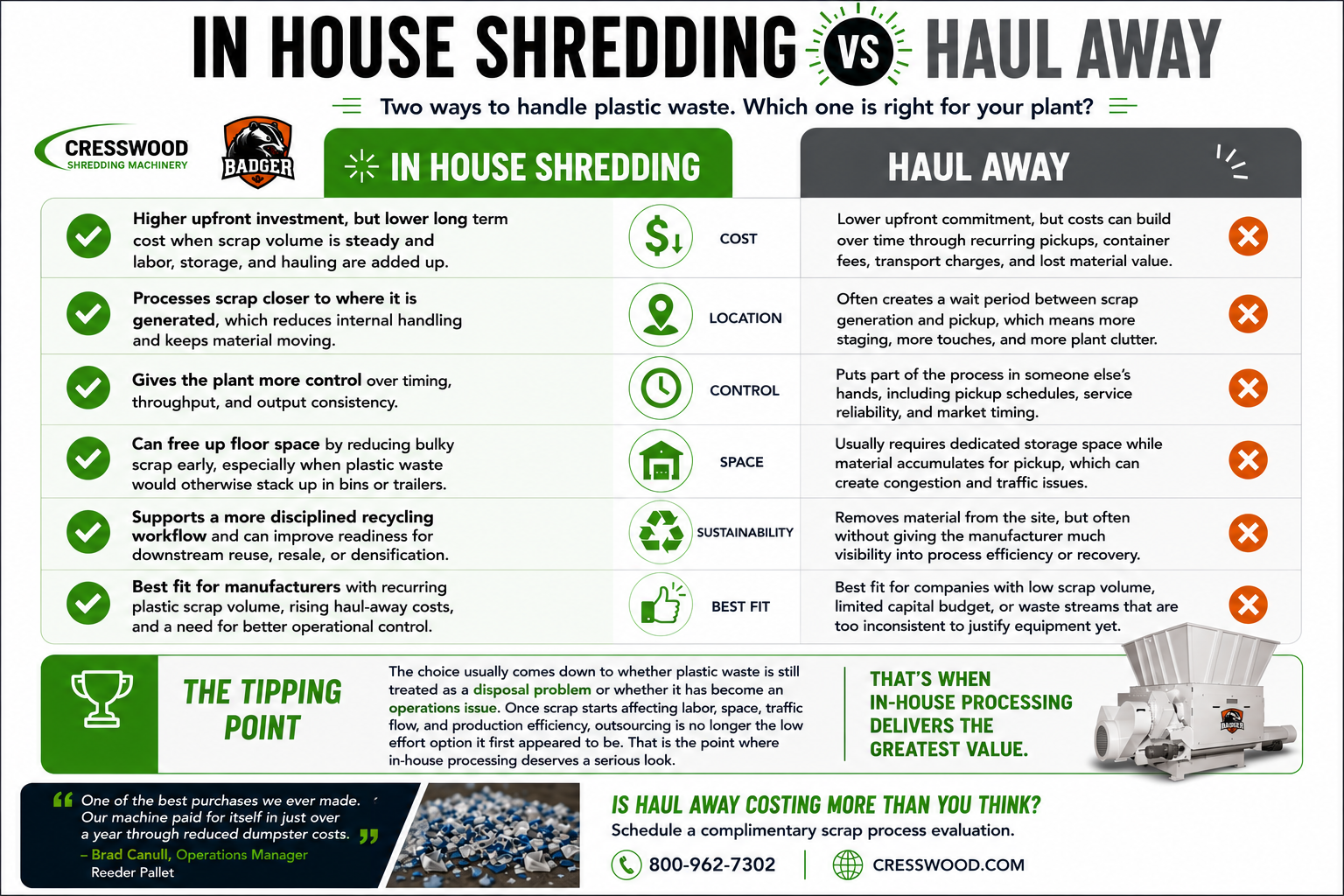
For plastics manufacturers generating high volumes of production scrap, the question isn’t whether to manage it. It’s how. Many facilities start by outsourcing: paying a toll processor to haul away waste and return reground material. It’s simple, requires no capital investment, and feels low-risk. But as production scales, more manufacturers are turning to plastic recycling pre-shredders to take control of their scrap stream at the source.
Until it isn’t.
We spoke with the general manager of a high-volume plastics manufacturing facility that runs eight production lines and has scaled from one in-line horizontal grinder system to eight over the past seven years, all powered by American-made industrial shredders and grinders. His experience reflects a broader shift in how manufacturers view production scrap: not simply as waste to manage, but as an opportunity waiting for the right process. His perspective? “If you’re not managing your scrap, you’re not really managing your business. It’s real money.”
The Hidden Costs of Outsourcing Scrap Recovery
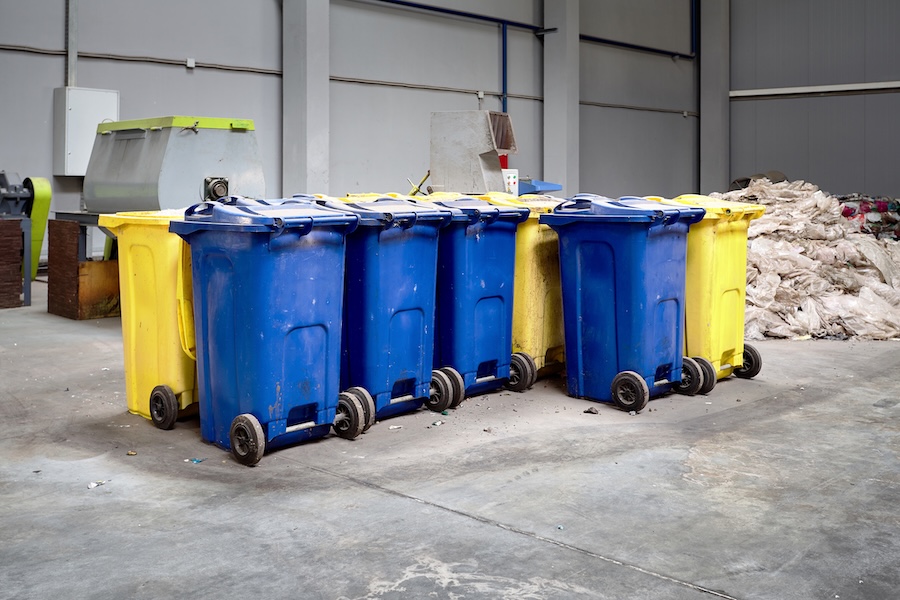
Toll processors charge by the pound. For facilities generating thousands of pounds of scrap per hour across multiple production lines, those costs compound fast. As we’ve explored in The Hidden Cost of Ineffective Scrap Management, the financial drain often goes far beyond what shows up on a hauling invoice.
For this manufacturer, in-house recovery has become so effective that they now use 99.4% of all virgin resin purchased, a figure directly attributable to their in-house recycling efforts. That kind of near-total material utilization is simply not achievable when scrap leaves the building.
But cost isn’t the only issue. Our interviewee identified an even bigger problem: quality risk.
“Even when we get behind or equipment goes down, outside toll processing carries with it an unreasonable level of risk,” he explained. “We’ve seen way too much contamination come back. When we get material back from an outside toll processor, it creates variation in the process. Our guys have to adjust. And that creates variation in output, which by definition is a quality problem.”
For manufacturers selling a premium product where color match, consistency, and quality differentiation matter, that risk is unacceptable.
When contaminated material came back from an outside processor, the consequences were immediate and disruptive. “We would get wildly varying Melt Indexes, which means that our folks were having to make process adjustments constantly,” the GM explained. “Unstable input equals quality issues. Period.” In one case, metal was found in the returned material, putting expensive production equipment at significant risk of damage. That single incident underscored why relying on an outside processor meant accepting a level of uncertainty that no quality-focused manufacturer should tolerate.
The Case for In-Line Grinding
This facility previously handled scrap in-house, but through a cumbersome batch process: chunking material and transporting it to a separate area of the building for processing. The shift to in-line shredder-grinder systems, specifically Cresswood’s horizontal EF30-75 grinders, changed everything.
“It moved a process we were already doing into the production line itself, as opposed to a secondary process in another part of our building,” the GM explained. “The biggest benefit was eliminating waste.”
He described conducting a “spaghetti diagram” analysis when he first arrived at the facility seven years ago, mapping how scrap moved through the plant.
“Prior to inline processing, all of our scrap would be moved to a different section of the building to be processed,” he recalled. “This created a ‘batch and queue’ flow. When we were short staffed, regrind would not get run, further compounding the challenge. We had recycled material in various states spread throughout the plant, and it took a sizable amount of extra management and material handling just to keep up.”

The in-line solution, built around Cresswood’s horizontal EF30-75 grinders and Badger rotor technology, eliminated multiple forms of manufacturing waste (known as “Muda” in lean manufacturing):
The result: “Our plant is cleaner. More organized. More streamlined. I don’t have all the material handling. I have fewer forklifts today than I used to. Our people are more effective at processing it. It’s been a huge win.”
Scaling: Why One Grinder Per Line Made Sense
The facility started with a single horizontal EF30-75 system as a trial on one production line.
Within a few months, the team knew they needed more capacity. But it wasn’t instant. “There were unanticipated challenges that we had to work through,” the GM said. “Kick back of material was a big concern, as was the sound generated by the equipment. We had to build custom solutions to mitigate both.” Once those issues were resolved, the ROI became undeniable, and the expansion plan took shape quickly.
“We did look at trying to share them,” the GM noted, “but we generate so many pounds on our line that there are moments where everything coming off the line has to go through the system. You’re talking thousands of pounds per hour.”
Each system had to be designed to handle both normal scrap loads and rare full-line events. That capacity requirement, combined with volume, made dedicated systems per line the only viable approach.
Today, the facility is adding its seventh and eighth systems. “Managing scrap correctly has led to the opportunity for us to continue to grow,” he said. “That’s the job: return an investment to ownership. And if you do that long enough, you get to ask for some money back.”
The Next Frontier: Automating Secondary Scrap Streams
Even with 90-95% of scrap handled by in-line horizontal grinders, this manufacturer is looking at the remaining 5-10%: material that requires degassing and pelletizing before reintroduction.
Currently, that secondary stream is manually fed. The next phase of their plan is a large, centralized hopper-fed grinder to automate the process, reducing labor costs and bringing even more of the waste stream back into the production loop.
The Sustainability Angle
While cost and quality drive the in-house decision for most manufacturers, there’s an increasingly important secondary benefit: sustainability. In-house scrap recovery means less material leaving the facility, fewer truck trips for haul-away services, and a tighter closed-loop production process. As Cresswood has outlined in Sustainable Solutions with American Made Plastic Recycling Shredders and Grinders, advancements in recycling technology are making closed-loop manufacturing more accessible than ever.
For manufacturers whose customers or end-users are tracking environmental metrics, in-house grinding provides a tangible, measurable sustainability story without requiring any process changes beyond what already makes financial sense.
From the Field: What Plant Floors Are Telling Us
Ryan Butzman, President & Director of Sales at Cresswood Shredding Machinery, has walked through hundreds of manufacturing facilities still relying on haul-away. The warning signs, he says, are hard to miss: full tippers lining the dock, multiple 40-yard containers on site, and entire rooms consumed by stacked gaylord boxes. Operations teams feel it first. Their job is to run production, and when managing scrap becomes a second full-time responsibility, productivity suffers. As volume grows, floor space gets “devoured by scrap,” as Butzman puts it, interrupting the smooth flow of production materials and making the plant less efficient by the month. (For more on this tipping point, see Why On-Site Shredding Is Becoming Non-Negotiable for Manufacturers.)
The cost most manufacturers underestimate is labor. A few minutes per operator here, 15 minutes there, seems trivial in isolation. But spread across 10 to 20 operators, every shift, all year, the cumulative spend on scrap handling becomes staggering. Butzman notes that scrap “remains useless until it goes through size reduction to a uniform particle”, meaning costs keep mounting until a company hits the critical point where a capital investment in processing equipment is justified against the yearly waste removal bill. The benchmark he sees most often: “If you can get an ROI of three years, the capital purchase begins to make sense to the CEO and CFO.” For facilities weighing those numbers, American-made industrial shredders and grinders offer a distinct advantage: domestic manufacturing means shorter lead times, local service, and equipment purpose-built for North American production environments.
For in-line systems like these, dependability is paramount. If the grinder systems go down, it has an immediate negative impact on production, something that an isolated centralized system doesn’t face. Price doesn’t even make the conversation. It is all about uptime and prompt support to back the equipment up. The job of a grinder is extremely abusive, and having equipment engineered to handle that punishment is critical. Having responsive, professional service and readily available parts is equally important to support the system for the long term. This is where low cost of ownership far outweighs any consideration of up-front price.
The payoff extends well beyond the balance sheet. Plant cleanliness, labor efficiency, and production flow all improve, often in ways that are difficult to quantify on a spreadsheet. Butzman points to one factor that rarely makes the capital expenditure request but matters enormously: morale. “People do better work and have more pride in their workplace when it is clean, safe, and organized,” he says. Employees who see their company investing in responsible material stewardship feel a stronger sense of purpose, and when that investment also benefits the bottom line, it creates what Butzman calls “a true win-win business solution.”
5 Signs You’ve Outgrown Plastic Waste Haul-Away Services
- Your toll processing bill scales faster than your revenue. Per-pound pricing punishes high-volume producers.
- You’ve experienced contamination or quality issues from returned material. Even one bad batch creates costly variation.
- Scrap is stacking up on your floor waiting for pickup. That’s inventory waste, blocked floor space, and safety risk.
- You’re moving material across the plant before it gets processed. Every forklift trip is non-value-added cost.
- Your production lines generate thousands of pounds per hour. At that volume, in-line processing isn’t a luxury. It’s an operational necessity.
The Bottom Line
“If you’re not managing your scrap, you’re not really managing your business. You got to pay attention to it. It’s real money.”
For high-volume plastics manufacturers, the math on in-house grinding gets clearer with every pound produced. The question isn’t whether you can afford to bring it in-house. It’s whether you can afford not to.
Ready to Take Control of Your Plastic Scrap?
The tipping point is different for every operation. Scrap volume, hauling costs, labor, floor space, contamination risk, and production goals all factor into whether in-house processing makes financial and operational sense.
Cresswood can evaluate your current scrap stream and help determine whether an in-line or centralized grinding system is the right fit for your facility.
Continue Exploring Plastic Recycling Solutions
- Solving Plastic and Film Recycling Pain Points for Manufacturers
- From Waste Stream to Feedstock: A Cresswood Client Story
- The Crucial Role of Industrial Grinders in Waste Reduction
- 5 Ways Recycling Equipment Reduces Manufacturing Waste
- Complete Plastic Recycling Solution

Plastic Waste Recycling Solutions
Cresswood understands that your primary shredder for plastics recycling must be safe, simple to clean and maintain, and flexible enough to produce uniform particle sizes from a variety of materials. Our American-made industrial shredders feature the Badger Cutterhead with forged drive shafts and indexable Dun Rite Tooling, delivering unmatched durability and performance in demanding plastic recycling environments.
Applications
- Purgings, Sprues and Runners
- Automotive Components
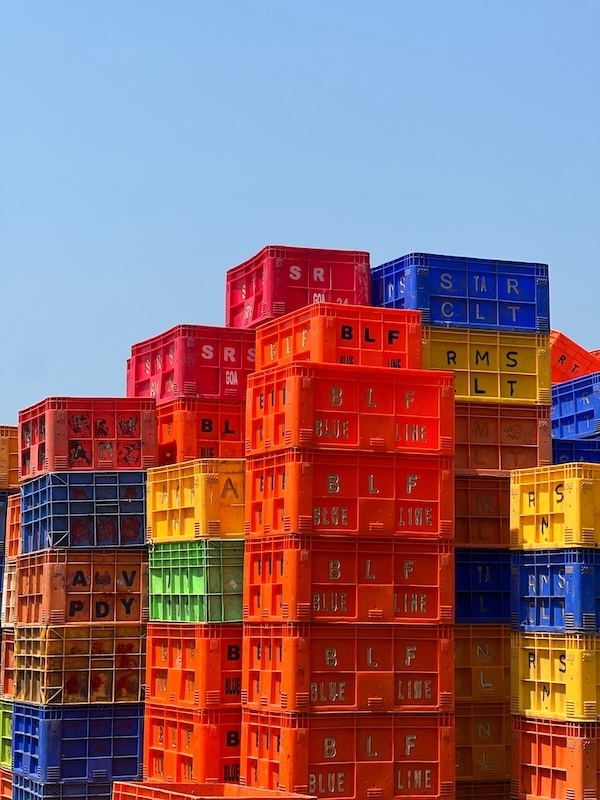
- Bins, Crates and Totes
- Pipe and Linear Rigid Plastic
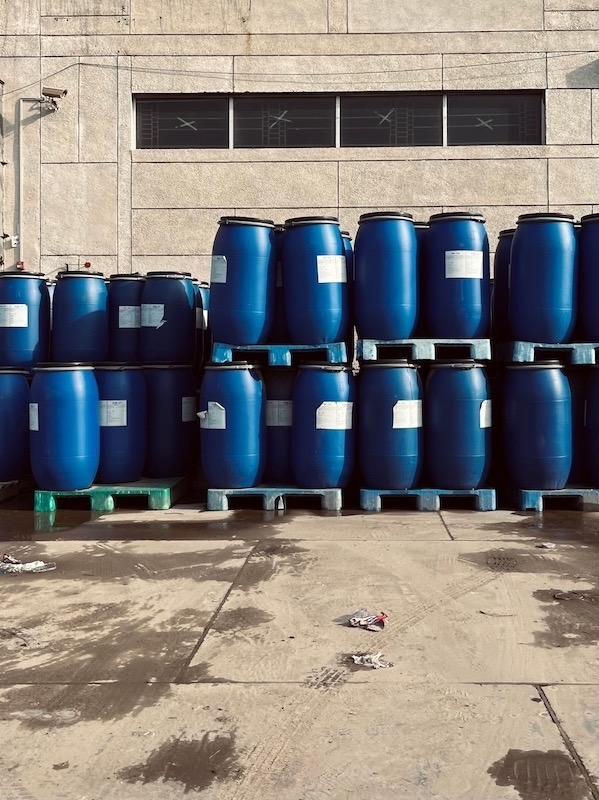
- Plastic Drums and Barrels
- PET, HDPE, LDPE, PVC and More!
 .
.  .
.
Complete Solution Providers
- Primary & Secondary Size Reduction
- Customized Material Handling
- Infeed and Discharge Conveyors
- Metal Detection and Separation
- Dust Collection
- System Control Integration
- Operator & Maintenance Training
Recent Comments