Cresswood’s American-made plastic recycling machines are engineered to deliver dependable performance across demanding plastic-processing applications. Our robust hopper-fed shredders and grinders provide exceptional durability, consistent output, and greater operational efficiency. Every machine is backed by experienced service and support before, during, and long after installation.
In our recent article on in-house shredding vs. outsourced haul-away, we explored how one high-volume plastics manufacturer moved from toll processing to in-line grinding and recovered 99.4% of all virgin resin purchased. That conversation surfaced a pattern we see across hundreds of facilities: there are reliable warning signs that your current scrap strategy has hit its ceiling, and that plastic recycling pre-shredders may be the missing piece in your production flow.
Here are five of them, and what each one actually costs you.

1. Your Toll Processing Bill Scales Faster Than Your Revenue
Per-pound pricing is simple. That is its appeal and its trap.
When production volume is modest, outsourcing scrap processing looks like a bargain. No capital investment, no headcount, no maintenance. But toll processors charge by weight, and as your lines ramp up, the math flips. Every new product run, every efficiency gain that increases output, also increases the waste stream. Your scrap bill grows in lockstep with production, but the margin on that production does not grow to match.
Ryan Butzman, President & Director of Sales at Cresswood Shredding Machinery, puts it bluntly: “If you can get an ROI of three years, the capital purchase begins to make sense to the CEO and CFO.” Most facilities generating thousands of pounds per hour cross that threshold sooner than they expect, particularly when they compare haul-away costs against the total cost of ownership for American made industrial shredders purpose-built for their material stream.
The benchmark is straightforward. Pull your annual toll processing and haul-away invoices. Compare them against the total cost of ownership for an in-line or centralized system, including equipment, installation, maintenance, energy, and labor. If the payback window is three years or less, the financial case is already made. If it is two years or less, you are actively losing money every month you wait.
Of course, the financial case on paper does not always eliminate hesitation in the boardroom. Butzman hears common pushback from CFOs evaluating in-house equipment, and he acknowledges that some of it is valid.
“Lack of electrical service or sufficient air for collection and material handling often comes up,” Ryan Butzman, President of Cresswood Shredding Machinery explains. “Both are costly upgrades, but they are essentially part of growing the organization and its capabilities. You have to ask about the importance of investing in the future of the company, because if you don’t, then the choices become very limited as far as adding equipment.”
The other frequent concern is equipment longevity and upkeep. Butzman’s answer is direct: “Partnering with a company that has strong after-sale support is critical in getting the most out of a large capital purchase. Purchasing durable equipment that is engineered for abuse isn’t cheap up-front, but it always comes with a much lower total cost of ownership and higher resale values.” The equipment OEM must build machines that are easy to work on and maintain, and provide clear instructions on proper preventive maintenance routines. When those elements are in place, the long-term economics overwhelmingly favor ownership over outsourcing.
2. You’ve Experienced Contamination or Quality Issues from Returned Material
This is the sign that moves fastest from inconvenience to crisis.
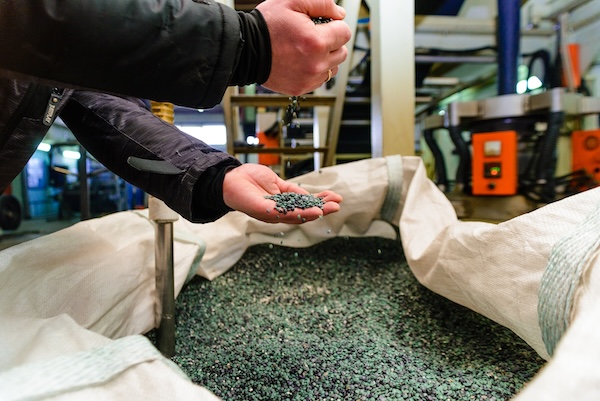
When scrap leaves your facility and comes back as regrind from an outside toll processor, you lose chain of custody. You cannot verify what else ran through their equipment before your material, what was stored near it, or how it was handled. One contaminated batch introduces variation into your process that cascades downstream.
As the general manager we interviewed for last month’s article described: “We would get wildly varying Melt Indexes, which means our folks were having to make process adjustments constantly. Unstable input equals quality issues. Period.”
For manufacturers selling a premium product where color match, consistency, and dimensional accuracy matter, contamination risk is not hypothetical. It is an operational liability. In one case, metal was found in returned material, putting expensive production equipment at risk of catastrophic damage. That single incident made the case for in-house processing louder than any spreadsheet ever could.
The question is not whether contamination will happen. It is how many times you are willing to absorb the cost before you decide the risk is unacceptable.
When you process your own scrap on your own equipment, whether rigid stock or flexible packaging run through plastic film shredders, you control the input, the output, and every step between. The material never leaves your sight. That control is what makes 99%+ resin utilization rates possible.
3. Scrap Is Stacking Up on Your Floor Waiting for Pickup
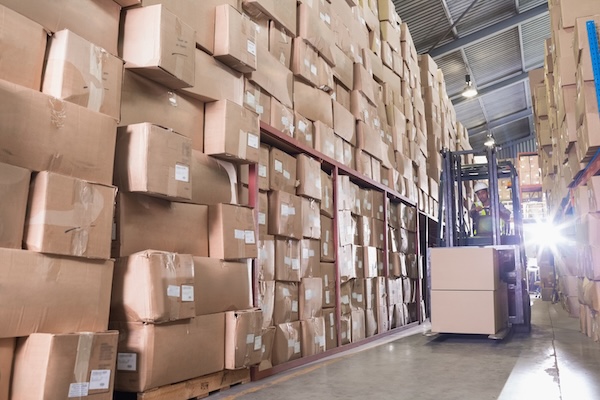
Walk through your plant. If you see gaylord boxes lining the walls, tippers parked along the dock, or entire rooms consumed by accumulated scrap, your waste collection schedule has already fallen behind your production rate.
This is not just a housekeeping issue. It is a compounding operational problem.
Floor space is production capacity. Every square foot occupied by scrap waiting for a hauler is a square foot unavailable for staging, assembly, or material flow. In facilities where lean manufacturing principles guide layout decisions, scrap accumulation is the opposite of progress. It represents inventory waste in its most visible form.
Beyond floor space, there is safety. Stacked gaylords shift. Overloaded containers create forklift hazards. Accumulated plastic scrap, particularly film and flexibles, presents fire risk when stored in volume. Insurance underwriters notice. OSHA inspectors notice. Your team notices every day. For operations generating high volumes of stretch wrap, poly bagging, or production film, dedicated plastic film recycling machines eliminate accumulation at the source rather than managing it after the fact.
Butzman describes walking into facilities where “floor space gets devoured by scrap, interrupting the smooth flow of production materials and making the plant less efficient by the month.” The fix is not a more frequent pickup schedule. It is eliminating the accumulation entirely by processing material at the point of generation.
With an in-line shredder-grinder system, scrap moves directly from production into size reduction without ever touching the floor, let alone sitting there for days waiting for the next truck.
4. You’re Moving Material Across the Plant Before It Gets Processed
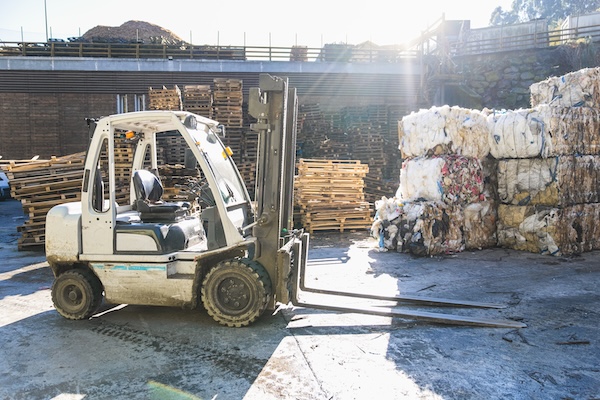
Every forklift trip that moves scrap from a production line to a holding area, from a holding area to a processing zone, or from a processing zone to a dock is non-value-added cost. It requires labor, equipment, fuel or electricity, and time. More importantly, it introduces handoffs, and every handoff is a point where material can be lost, damaged, contaminated, or simply forgotten.
One plant manager described conducting a “spaghetti diagram” analysis of scrap movement and discovering that material was being touched five or six times before it was either processed or loaded for haul-away. That kind of unnecessary motion is what lean practitioners call “Muda,” and it is almost always invisible until someone maps it.
The in-line alternative eliminates the spaghetti entirely. Material goes from the production line directly into a dedicated shredder-grinder system, is reduced to uniform particle size, and is returned to the process or stored in a single, controlled location. No forklifts. No batch queues. No secondary material handling. Whether your scrap stream is rigid purge, trim, or flexible packaging processed through plastic film recycling shredders, the principle is the same: reduce material where it is generated, not somewhere else in the building.
The result is not just cost savings. It is operational clarity. Fewer people are needed to manage scrap. Fewer forklifts are needed on the floor. The plant becomes cleaner, more organized, and easier to manage. As one facility GM told us: “I have fewer forklifts today than I used to. Our people are more effective. It’s been a huge win.”
5. Your Production Lines Generate Thousands of Pounds Per Hour
At a certain volume threshold, in-line processing stops being an upgrade and becomes an operational necessity.
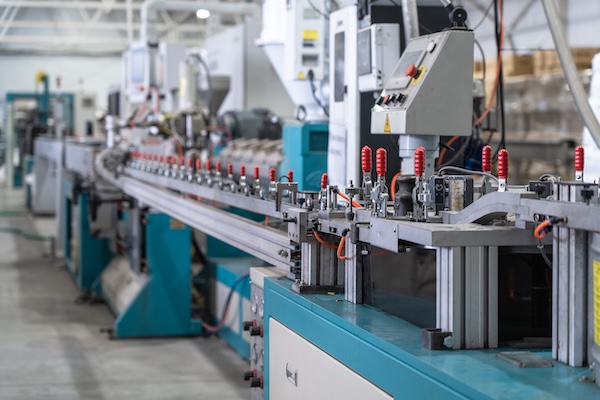
When each production line generates thousands of pounds of scrap per hour, no batch process, no centralized system shared across multiple lines, and certainly no outside hauler can keep pace without creating bottlenecks. The scrap stream at that volume demands dedicated capacity, purpose-built to handle both steady-state loads and the occasional full-line purge events where everything coming off the line must go through size reduction immediately.
This is why the facility we profiled in our June article moved from a single trial unit to eight dedicated horizontal EF30-75 grinder systems, one per production line. They explored sharing systems between lines and quickly found it was not viable. Volume dictated the architecture.
If your output has reached the thousands-of-pounds-per-hour range, your scrap solution needs to match that throughput without hesitation. Anything less creates a constraint in your production flow, and constraints cost money every minute they are active.
At this scale, equipment dependability becomes paramount. If the grinder goes down, production feels it immediately. That is why world class industrial grinders engineered for punishing duty cycles, backed by responsive service and readily available parts, matter more than purchase price. As Butzman notes, “Price doesn’t even make the conversation. It is all about uptime and prompt support.”
If that sentence sounds familiar, you are not alone. Butzman hears it regularly, and the root cause is almost always the same: the wrong equipment for the application.
“There are a couple of things that can lead to this conclusion,” Butzman explains. “The first is being sold equipment or a system that wasn’t designed or engineered for the application at hand. A grinder made for wood works perfectly in that application, but will fail spectacularly if fed flexible film. Feed rate, tooling clearances, rotor design, and drive package choices all matter.”
But the shredder itself is only part of the equation. How the scrap is introduced into the system and conveyed away are just as important. Much thought has to be put into harmonizing the entire flow of materials to guarantee success. A system that shreds effectively but cannot keep up with infeed or outfeed rates will still create bottlenecks and frustration.
This is where Cresswood’s consultancy sales approach builds trust. “Working with a provider who really listens to what you need and can engineer the system to its specific requirements is essential,” Butzman says. “If we can’t confidently solve an application, we won’t make a short-term sale at the expense of our reputation. We also will not walk away from unexpected challenges. You want to work with an OEM with deep experience and expertise, who will leverage all of their resources in finding and implementing solutions to complex problems.”
A failed first attempt at in-house shredding is not evidence that in-house shredding does not work. It is evidence that the previous provider did not do the engineering homework. The right system, properly designed for your specific material stream and production environment, eliminates the problems that made the first attempt fail.
How Many Signs Do You Recognize?
Most facilities that contact Cresswood identify with two or three of these indicators before making the call. By the time all five are present, the cost of inaction is usually measured in hundreds of thousands per year, between hauling fees, labor, floor space, quality losses, and missed material recovery.
The good news: these problems are solvable, often with a phased approach that starts with a single system on your highest-volume line and scales from there. Facilities handling film and flexible materials are also finding that advancements in plastic film recycling technology have made closed-loop recovery viable where it was not even five years ago.
What Happens Next
The transition from collection and haul-away to in-house shredding does not require shutting down production or overhauling your plant layout. For most facilities, the path looks like this:
- Scrap stream assessment. Identify your material types, volumes per line, and current handling costs.
- System sizing. Match equipment capacity to peak throughput requirements, not averages.
- Trial deployment. Start with one line. Prove the ROI. Build internal support for expansion.
- Scale. Add systems as production grows, knowing the economics are already validated.
Cresswood’s American made industrial shredders and grinders are purpose-built for this progression, from single-unit pilots to full-facility deployments.
Ready to Evaluate Your Operation?
If you recognized your facility in any of the five signs above, the next step is a scrap stream evaluation. Cresswood can help you quantify what your current process is costing, model the payback on in-house equipment, and recommend a system sized to your specific production environment.
Cresswood’s American-made plastic recycling machines are engineered to deliver dependable performance across demanding plastic-processing applications. Our robust hopper-fed shredders and grinders provide exceptional durability, consistent output, and greater operational efficiency. Every machine is backed by experienced service and support before, during, and long after installation.
Contact our team to start the conversation!
Explore More About In-House Plastic Shredding and Recycling
- In-House Shredding vs. Outsourced Haul-Away: When Does It Make Sense to Bring Plastic Grinding In-House?
- Solving Plastic and Film Recycling Pain Points for Manufacturers
- Why On-Site Shredding Is Becoming Non-Negotiable for Manufacturers
Recent Comments